
 Philip's Piano Academy
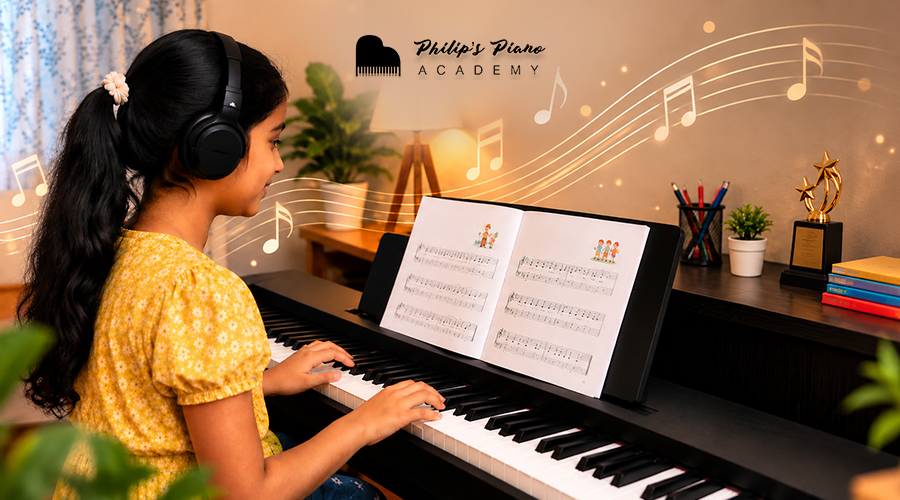
Can you learn piano properly through a screen, especially when you are starting from scratch? It is a reasonable question. A beginner needs clear explanations, individual feedback and a way to understand what happens between one lesson and the next.
At Philips Piano Academy, online piano classes follow Ajith Philip’s established teaching method. Every session is live and one-on-one, with the same learning content, lesson progression and teaching standards used in our studios. A central part of this approach is helping students become capable of learning independently, beginning with their very first class.
Learning to Understand, Not Just Follow
Independent learning does not mean being left to work everything out alone. Your teacher explains each concept, guides you through it and helps you understand how to apply it yourself.
From the beginning, students learn to recognise notation, understand rhythm and connect the written music with the keyboard. The aim is to know why and how something works, so you can use that understanding when you meet it again in another piece.
This is particularly important at home. When you sit down to practise, you need more than a memory of your teacher’s demonstration. You need to understand what the music asks you to do and how to approach it.
A Structure for Completing Each Lesson
Lessons follow a clear sequence. Beginners work through notation, rhythm, coordination and technique in manageable steps, using internationally used method books that include John Thompson’s Easiest Piano Course series.
Introducing a lesson is only the beginning. Students practise the material, return to it with their teacher and demonstrate their understanding before it is marked complete. Any difficulties are addressed before moving ahead.
This gives both student and teacher a clear picture of what has been understood and what still needs work. Progress comes from building secure foundations, with each completed lesson preparing the student for what follows.
Why This Approach Supports Online Learning
Ajith Philip has spent several years teaching students from different countries, online and in the studio. His experience has shaped an approach in which clear explanation, guided practice and independent understanding work together.
Every faculty member trains under him and follows his established system without changing its structure. Online students work towards the same understanding and complete lessons through the same process as studio students.
The teacher remains actively involved throughout. Your camera is positioned above the keyboard so the keys and fingers are clearly visible. The teacher listens, observes your playing and helps you address difficulties as they arise.
If you hesitate over a note or lose the rhythm, you can revisit that section together. There is time to ask questions, repeat an explanation and check that you can apply it. Learning online saves travelling time while maintaining the quality and individual attention of a studio lesson.
Sight-Reading Opens the Way to New Music
Sight-reading sits at the heart of Ajith Philip’s method because it supports the ability to learn unfamiliar music. Students gradually become less dependent on copying movements or memorising a demonstration.
Reading develops alongside listening, coordination, technique and expression. At first, a short passage may need careful attention. With regular practice and guidance, students become more comfortable recognising and applying what they have learnt.
Although our foundation is classical, the academy also has expertise in contemporary and popular music. Students explore different styles through repertoire appropriate to their level.
Getting Ready to Learn from Home
You will need a piano or suitable electronic keyboard, a reliable internet connection and a device arranged so your teacher can see and hear your playing clearly. We can discuss your setup before lessons begin.
If you are comparing an online keyboard course with piano instruction, ask what the teaching covers. Philips Piano Academy is dedicated exclusively to piano. A suitable keyboard can support early learning, while lessons focus on music reading and piano playing.
Before your first online keyboard lesson, speak with us about the instrument you own. We can advise on its suitability and explain what you may need as your skills develop.
Experience the Method in a Trial Session
The best way to understand our online piano lessons is to experience the teaching. A trial lets you discuss your goals, ask questions and see how the teacher guides you towards understanding a concept for yourself.
For those considering studio lessons, our centres are in Koramangala and Harlur Road, Bangalore. Our third branch at Park Square Mall, Whitefield, is opening soon.
Book an online trial with Philips Piano Academy to experience the approach and quality of instruction from home before you enrol.